

Liver fluke is not found by a standard worm count, so it has its own test. Alpacas and llamas are very susceptible to liver fluke, and it can cause serious illness and sudden death, so it is worth testing in the right season, especially if your animals graze wet land.
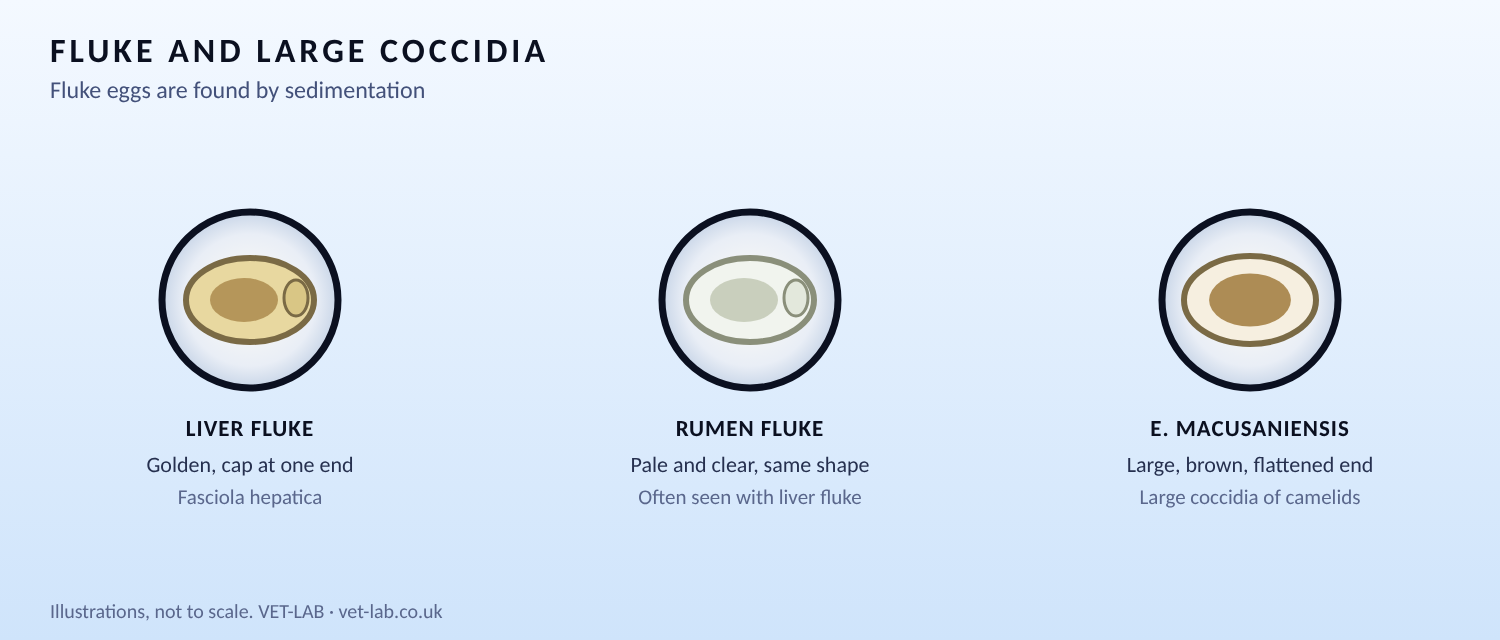
Fluke eggs as seen under the microscope, with a large coccidial oocyst for comparison. Illustrations, not to scale.
Liver fluke (Fasciola hepatica)
Liver fluke is carried by the mud snail and picked up on wet pasture. In camelids it can cause weight loss, poor condition, anaemia and sudden death. Our fluke egg test uses sedimentation to find fluke eggs in dung. Eggs are only shed by adult flukes, which take several weeks to develop (around 10 to 12 weeks in sheep and cattle), and are shed intermittently, so a negative result does not rule out fluke. If you suspect acute fluke in the autumn, speak to your vet.
Rumen fluke (Calicophoron daubneyi)
Rumen fluke uses the same mud snail host and has been reported in camelids. Its eggs look very like liver fluke eggs but are paler and clearer, and they are reported separately when seen. The same test finds both.
When to test
- Late autumn to winter, and again in spring, on land that is wet or where animals have grazed fluke areas
- New purchases: test before they join the herd
- After treatment: check that fluke eggs have cleared
Taking the sample
Collect fresh dung, ideally from that morning, from several animals in the group or from the pile they use. Use the pot and gloves in the kit, keep the sample cool, seal it and post it Monday to Wednesday.
Ready to test?
Collect fresh dung at home, post it free to our laboratory (Monday to Wednesday) and your result appears in your account within 24 to 48 hours of the lab receiving your sample.
Order a camelid test kitMore camelid guides
This page is general information, not veterinary advice. If your animals are unwell, or you are unsure what to do, speak to your vet.