
Chickens, ducks, geese and turkeys can all carry internal worms. Most birds cope with a low burden, but heavy burdens can cause weight loss, poor laying and ill health, so it helps to know what is in your flock.
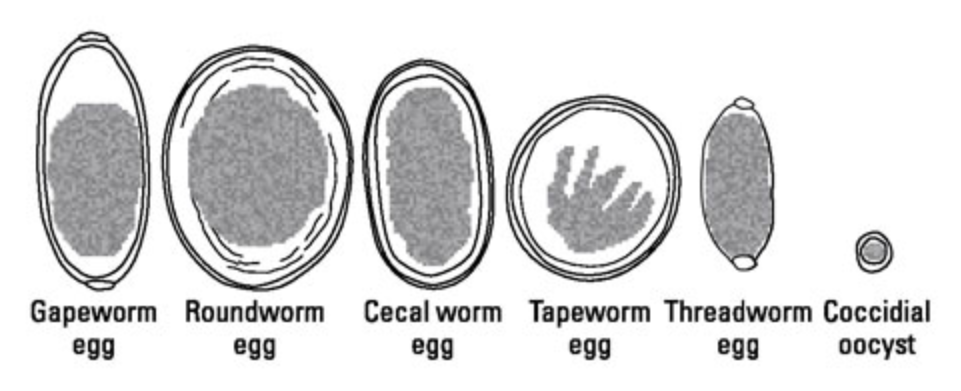
The main worm eggs found in poultry droppings, with a coccidial oocyst for comparison. Threadworm is also called hairworm or capillary worm. Coccidia are not worms, but their oocysts can also be seen on the test.
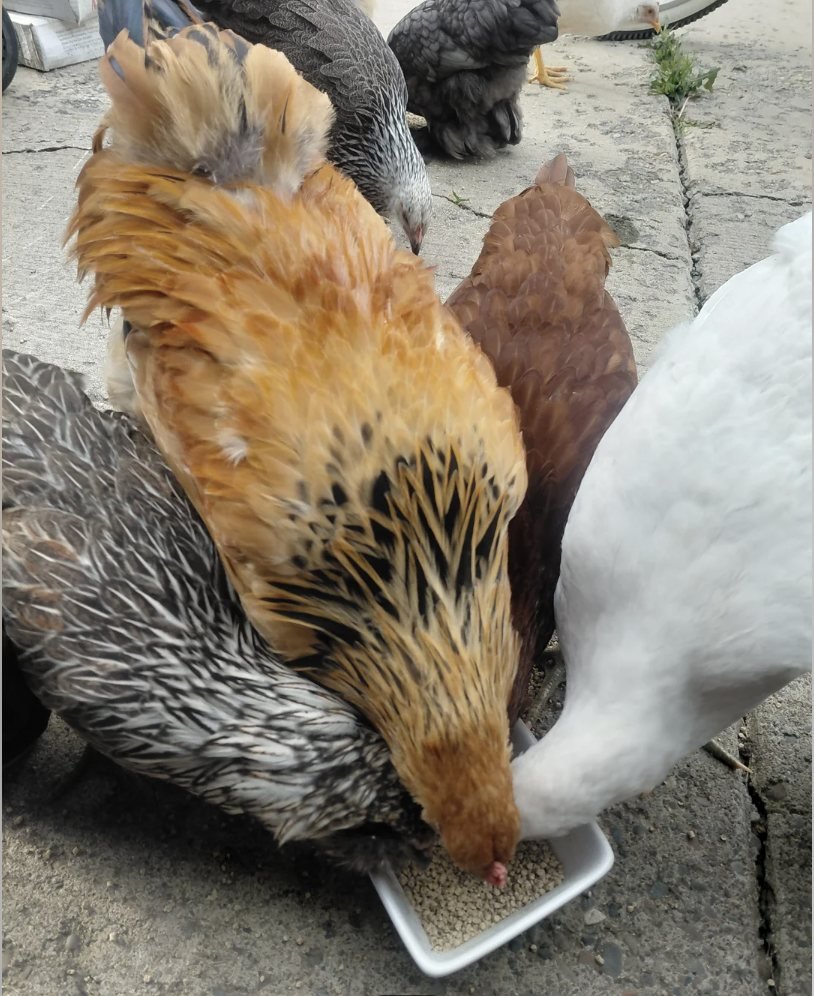
Birds sharing feeders and ground can pass worm eggs between them.
Roundworm (Ascaridia)
The large roundworm of poultry lives in the small intestine. Birds pick up eggs from contaminated ground, feed and water. Heavy burdens can cause weight loss, poor growth and diarrhoea, and in severe cases a blocked gut.
Caecal worm (Heterakis)
Caecal worms live in the caeca, the two blind pouches off the gut. They rarely cause illness on their own, but they can carry the organism that causes blackhead disease, which is especially serious in turkeys and can also affect chickens and game birds. Their eggs look very similar to roundworm eggs.
Hairworm or capillary worm (Capillaria)
These thin, thread-like worms live in the crop, oesophagus and intestines. They can damage the gut lining and cause weight loss, poor appetite and sometimes death, especially in younger birds. Eggs are small, with a plug at each end.
Tapeworm
Poultry tapeworms need an intermediate host such as an ant, beetle, slug or snail, so birds on free range are most exposed. Tapeworm eggs are shed in packets with the droppings, intermittently, so they are easily missed on a single sample.
Gapeworm (Syngamus)
Gapeworm lives in the windpipe and can cause gaping, head shaking, coughing and gasping. Birds can be infected by eating earthworms or snails that carry the larvae. Eggs coughed up and swallowed are passed in the droppings, so they can be found on a worm egg count.
Coccidia (Eimeria)
Coccidia are microscopic parasites of the gut, not worms. Birds pass tiny egg-like oocysts in their droppings, and these float in the same solution as worm eggs, so we can report them on the same test. Most flocks carry a few, so a low number is normal. High numbers matter most in young birds, or where birds have bloody or watery droppings, ruffled feathers or poor growth. We report coccidia as none, low, moderate or high.
What the test does not cover
The test looks for worm eggs and coccidial oocysts. It does not test for red mite or lice, or bacterial and viral disease. If birds are unwell, speak to your vet.
Ready to test?
Collect fresh droppings from up to 5 birds at home, post them free to our laboratory (Monday to Wednesday) and your result appears in your account within 24 to 48 hours of the lab receiving your sample.
Order an avian test kitMore poultry guides
This page is general information, not veterinary advice. If your birds are unwell, or you are unsure what to do, speak to your vet.