
Alpacas and llamas carry worms that are similar to those of sheep and cattle. A low burden is normal and most animals cope, but heavy burdens cause weight loss, poor fleece, anaemia and illness, especially in young animals (crias), so it pays to know what is in your herd before you treat.
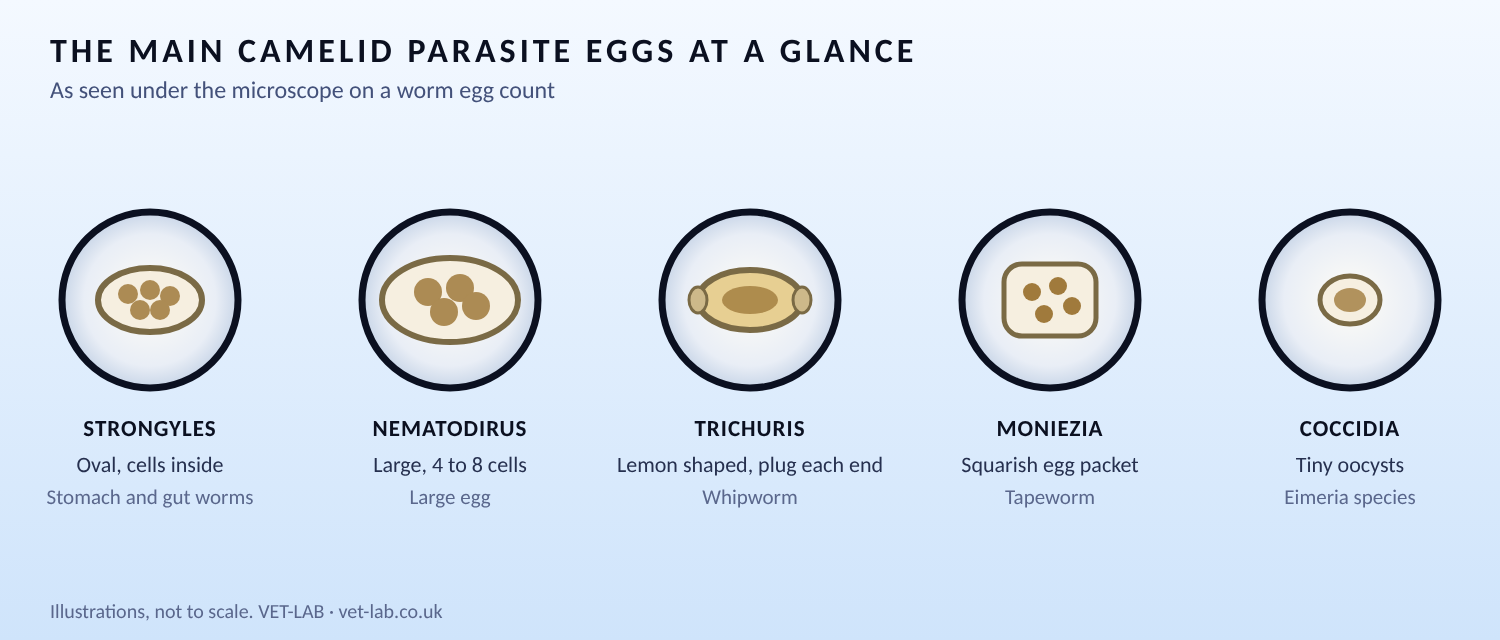
The main parasite eggs found on a camelid worm egg count. Illustrations, not to scale. Coccidia are not worms, but their oocysts are also seen on the test.
Stomach and gut roundworms
The most important are Trichostrongylus, Camelostrongylus, Teladorsagia and the blood-feeding barber's pole worm, Haemonchus contortus, which causes anaemia, pale gums and eyelids, weakness and sometimes a swollen jaw ("bottle jaw"). Their eggs look alike on a standard count, so they are reported together as roundworm (strongyle) eggs. Camelids can pick these up from pasture shared with sheep and goats.
Nematodirus
Nematodirus is a gut roundworm that is also found in camelids. Its eggs are large and easy to recognise, and are reported separately.
Whipworm (Trichuris)
Whipworm lives in the large intestine. Its lemon-shaped eggs, with a plug at each end, are shed in small numbers and are often found on a routine count. Heavier burdens can cause poor growth and loose dung.
Tapeworm
Camelids can carry Moniezia tapeworm, picked up from mites on pasture. Tapeworm is rarely a serious problem, and egg packets are shed intermittently, so they are easily missed on a single sample.
Coccidia (Eimeria)
Coccidia are microscopic gut parasites, not worms. Camelids can carry several kinds, including the large Eimeria macusaniensis, and young animals are most affected, with scouring, weight loss and poor growth. Oocysts float in the same solution as worm eggs, so we report them on the same test as none, low, moderate or high. Illness can occur before many oocysts are being shed, so speak to your vet if a cria is poorly even when the count is low.
Liver fluke
Liver fluke needs a different test. See our guide to liver fluke in alpacas and llamas.
What the test does not cover
The worm egg count looks for worm eggs and coccidial oocysts. It does not test for lice, mites, ticks or bacterial and viral disease. If animals are unwell, speak to your vet.
Ready to test?
Collect fresh dung at home, post it free to our laboratory (Monday to Wednesday) and your result appears in your account within 24 to 48 hours of the lab receiving your sample.
Order a camelid test kitMore camelid guides
This page is general information, not veterinary advice. If your animals are unwell, or you are unsure what to do, speak to your vet.